ActivityProfessional.Com Login


renewal cycles. Complete
some now & some later.
and Get 25% off
the Total price!
Buy 3 Courses
and Get 30% off
the Total price!
Buy 4 Courses
and Get 35% off
the Total price!
Contact:
info@activityprofessional.com
330.835.5009
(M-F 9:30-9:00 Eastern)
or
Voice Mail: 925-391-0363
| Questions? 800.667.7745; Voice Mail: 925-391-0363 Email: info@activityprofessional.com | ||
| Create Account | Login | ||


Section 4
Track #4: Finding Time Ratio Demonstration
Table of Contents | NCCAP/NCTRC CE Booklet
The
link below is to a section of a seminar lecture given by an instructor.
(Important note: Once the small video screen appears, if
you click on this screen the small video screen will drop behind this screen.
So to see the small video screen, drag this screen to the side.)
Right click and Open wmv file to
View
Track 4
Note-Taking Exercise
The percentage of loners in a facility may vary based on what 5 factors?
1.
2.
3.
4.
5.
Participant Sample Finding Time Ratios from DVD
Connie
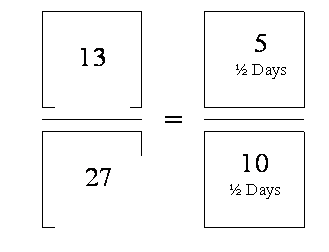
Mark
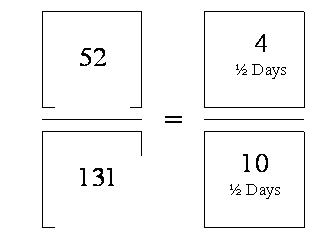
Mary
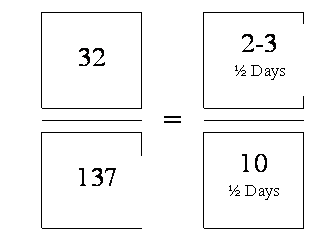
Your Facility
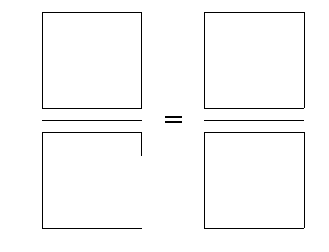
The Time-Ratio Solution – How much time is enough time?
The circle to the left below illustrates an example of a hypothetical facility in which there are 60 non-interviewable light care residents. The circle to the right below illustrates that in 10 segments of programming time, five of the segments are used for non-interviewable light care residents. Thus the types of programs offered are in proportion to the type of resident in that facility. When you fill in the blank circles below, ideally the portion of your resident population that is the largest in the circle on the left, labeled "Resident Population" should be reflected by the largest portion in the circle on the right, labeled "Weekly Programs." In short, if most of your residents are non-interviewable light care residents, most of your programming time should be allocated to them. Non-interviewable light care residents are defined in the preceding.
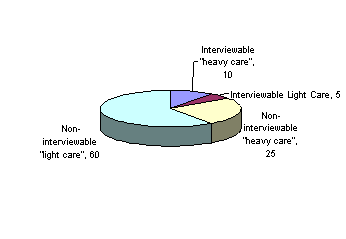
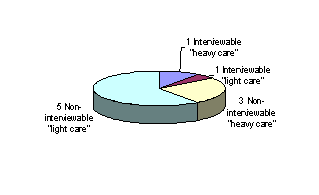
Resident Population

Weekly Programs

QUESTION #4: If 1/2 of your resident population is Loners, or 1/3 of your resident population is Loners, how much of your programming time should be spent with them?
NCCAP/NCTRC CE Booklet
Forward to Track
5
Back to Track 3
Table of Contents
Top